 Add to Chrome
 Add to Firefox
 Add to Edge
When Think-with-Image Meets Safety: What Determines Multimodal Jailbreak Robustness?
May 27, 2026
Think-with-image reasoning is emerging as a new inference paradigm for large vision-language models, but its safety implications remain poorly understood. Existing systems already span multiple process designs, including direct response generation, text-only prior turn, visual-state manipulation, and explicit external image-tool invocation. In this paper, we ask which of these evaluated paradigms improves multimodal jailbreak robustness, and why. Across multiple vision-language models, explicit image-tool interaction yields the lowest attack success rates in our experiments, reducing jailbreak success by around 30% relative on average across the evaluated models. This finding is initially surprising: ASR remains low even when the returned image-tool output is manually overridden or itself unsafe-looking, but returns near direct-answering levels under text-only prior turn controls. These results indicate that the lower ASR is not explained by benign returned-image semantics or by the textual image-tool trace alone. To explain the pattern, we introduce an image-tool safety vector framework that models image-tool invocation as a residual shift in hidden representations toward a safety-relevant direction. Representation-level analyses and activation interventions support this account. Overall, our results suggest that explicit image-tool interaction is a promising design pattern for improving jailbreak robustness, while also motivating pipeline-specific safety evaluation.

AgentLens: Revealing The Lucky Pass Problem in SWE-Agent Evaluation
May 13, 2026Evaluation of software engineering (SWE) agents is dominated by a binary signal: whether the final patch passes the tests. This outcome-only view treats a principled solution and a chaotic trial-and-error process as equivalent. We show that this equivalence is empirically false. We evaluate 2,614 OpenHands trajectories from eight model backends on 60 SWE-bench Verified tasks. Of these, 47 have enough passing trajectories to construct task-level process references, yielding a 1,815-trajectory evaluation subset. Among passing trajectories in this subset, 10.7% exhibit behavior we call a Lucky Pass: regression cycles, blind retries, missing verification, or temporally disordered exploration, implementation, and verification. We introduce AgentLens, a framework for process-level assessment of SWE-agent trajectories, and release AgentLens-Bench, a dataset of 1,815 trajectories annotated with quality scores, waste signals, divergence points, and 47 task-level Prefix Tree Acceptor (PTA) references. AgentLens builds PTA references by merging multiple passing solutions for the same task, and uses a context-sensitive intent labeler to assign actions to Exploration, Implementation, Verification, or Orchestration based on trajectory history rather than tool identity alone. On AgentLens-Bench, the quality score separates passing trajectories into Lucky, Solid, and Ideal tiers and further decomposes Lucky Passes into five recurring mechanisms. Across the eight model backends, Lucky rates range from 0.5% to 23.2%, and some models move by as many as five rank positions when ranked by quality score instead of pass rate. We release the anonymized project repository, including the AgentLens-Bench dataset and AgentLens SDK, at https://github.com/microsoft/code-agent-state-trajectories/.
Multi-Rollout On-Policy Distillation via Peer Successes and Failures
May 12, 2026Large language models are often post-trained with sparse verifier rewards, which indicate whether a sampled trajectory succeeds but provide limited guidance about where reasoning succeeds or fails. On-policy distillation (OPD) offers denser token-level supervision by training on student-generated trajectories, yet existing methods typically distill each rollout independently and ignore the other attempts sampled for the same prompt. We introduce Multi-Rollout On-Policy Distillation (MOPD), a peer-conditioned distillation framework that uses the student's local rollout group to construct more informative teacher signals. MOPD conditions the teacher on both successful and failed peer rollouts: successes provide positive evidence for valid reasoning patterns, while failures provide structured negative evidence about plausible mistakes to avoid. We study two peer-context constructions: positive peer imitation and contrastive success-failure conditioning. Experiments on competitive programming, mathematical reasoning, scientific question answering, and tool-use benchmarks show that MOPD consistently improves over standard on-policy baselines. Further teacher-signal analysis shows that mixed success-failure contexts better align teacher scores with verifier rewards, indicating that the gains arise from more faithful, instance-adaptive supervision. These results indicate that effective on-policy distillation should exploit the student's multi-rollout trial-and-error behavior rather than treating rollouts as isolated samples.
DataDignity: Training Data Attribution for Large Language Models
May 07, 2026Auditing language-model outputs often requires more than judging correctness: an auditor may need to identify which source document most likely supports the knowledge expressed in a response. We study this as pinpoint provenance: given a prompt, a target-model response, and a candidate corpus, rank the documents that best support the response. We introduce FakeWiki, a controlled benchmark of 3,537 fabricated Wikipedia-style articles designed to preserve ground-truth provenance while weakening lexical shortcuts. FakeWiki includes QA probes, source-preserving paraphrases, retro-generated variants, hard anti-documents that remain topically similar while removing answer-critical facts, and five query conditions: clean prompting plus four jailbreak-inspired transformations. We evaluate seven retrieval baselines, a training-free activation-steering retrieval-fusion method, SteerFuse, and a supervised contrastive provenance ranker, ScoringModel. ScoringModel maps response and document features into a shared space and is trained with InfoNCE using in-batch, retrieval-mined, and anti-document negatives. Across nine open-weight instruction-tuned LLMs and five query conditions, ScoringModel improves mean Recall@10 from 35.0 for the strongest retrieval baseline to 52.2, without inference-time fusion, and wins 41/45 model-by-condition cells. SteerFuse is usually second-best despite requiring no supervised training, showing that activation-space evidence can efficiently complement text retrieval. On jailbreak-inspired transformed queries, ScoringModel improves Recall@10 by 15.7 points on average over the best baseline. Overall, our work shows that robust training data attribution requires evaluation settings that separate true answer support from topical or lexical resemblance.
Chain of Risk: Safety Failures in Large Reasoning Models and Mitigation via Adaptive Multi-Principle Steering
May 07, 2026Large reasoning models (LRMs) increasingly expose chain-of-thought-like reasoning for transparency, verification, and deliberate problem solving. This creates a safety blind spot: harmful or policy-violating content may appear in reasoning traces even when final answers appear safe. We test whether final-answer safety is a sufficient proxy for the full reasoning-answer trajectory by scoring both stages under a unified twenty-principle safety rubric. Using prompts from seven public harmfulness and jailbreak sources, plus four out-of-distribution (OOD) sources, we evaluate 15 open-weight and API-based LRMs across 41K prompts per model. Reasoning traces consistently reveal additional safety risks beyond final answers, especially in high-severity stage-wise failures: leak cases, where unsafe reasoning precedes a safe-looking answer, and escape cases, where benign-looking reasoning precedes an unsafe final response. Principle-level analysis shows that risk concentrates in misinformation, legal compliance, discrimination, physical harm, and psychological harm. We further propose adaptive multi-principle steering, a white-box test-time mitigation that learns one unsafe-to-safe activation direction per safety principle and activates only directions whose current hidden state is closer to the unsafe than safe centroid. On three steerable open reasoning models, adaptive steering reduces unsafe counts in both reasoning traces and final answers on held-out and OOD benchmarks. DeepSeek-R1-Qwen-7B achieves a 40.8% average unsafe-count reduction while retaining 97.7% macro-averaged accuracy on BBH, GSM8K, and MMLU. These results suggest that LRM safety should be evaluated and mitigated over the full exposed reasoning-answer trajectory, not only at the final-answer stage.
Seek-and-Solve: Benchmarking MLLMs for Visual Clue-Driven Reasoning in Daily Scenarios
Apr 16, 2026Daily scenarios are characterized by visual richness, requiring Multimodal Large Language Models (MLLMs) to filter noise and identify decisive visual clues for accurate reasoning. Yet, current benchmarks predominantly aim at evaluating MLLMs' pre-existing knowledge or perceptual understanding, often neglecting the critical capability of reasoning. To bridge this gap, we introduce DailyClue, a benchmark designed for visual clue-driven reasoning in daily scenarios. Our construction is guided by two core principles: (1) strict grounding in authentic daily activities, and (2) challenging query design that necessitates more than surface-level perception. Instead of simple recognition, our questions compel MLLMs to actively explore suitable visual clues and leverage them for subsequent reasoning. To this end, we curate a comprehensive dataset spanning four major daily domains and 16 distinct subtasks. Comprehensive evaluation across MLLMs and agentic models underscores the formidable challenge posed by our benchmark. Our analysis reveals several critical insights, emphasizing that the accurate identification of visual clues is essential for robust reasoning.
Bradley-Terry and Multi-Objective Reward Modeling Are Complementary
Jul 10, 2025Reward models trained on human preference data have demonstrated strong effectiveness in aligning Large Language Models (LLMs) with human intent under the framework of Reinforcement Learning from Human Feedback (RLHF). However, RLHF remains vulnerable to reward hacking, where the policy exploits imperfections in the reward function rather than genuinely learning the intended behavior. Although significant efforts have been made to mitigate reward hacking, they predominantly focus on and evaluate in-distribution scenarios, where the training and testing data for the reward model share the same distribution. In this paper, we empirically show that state-of-the-art methods struggle in more challenging out-of-distribution (OOD) settings. We further demonstrate that incorporating fine-grained multi-attribute scores helps address this challenge. However, the limited availability of high-quality data often leads to weak performance of multi-objective reward functions, which can negatively impact overall performance and become the bottleneck. To address this issue, we propose a unified reward modeling framework that jointly trains Bradley--Terry (BT) single-objective and multi-objective regression-based reward functions using a shared embedding space. We theoretically establish a connection between the BT loss and the regression objective and highlight their complementary benefits. Specifically, the regression task enhances the single-objective reward function's ability to mitigate reward hacking in challenging OOD settings, while BT-based training improves the scoring capability of the multi-objective reward function, enabling a 7B model to outperform a 70B baseline. Extensive experimental results demonstrate that our framework significantly improves both the robustness and the scoring performance of reward models.
CCL-LGS: Contrastive Codebook Learning for 3D Language Gaussian Splatting
May 26, 2025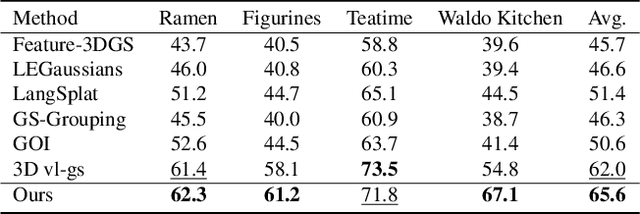
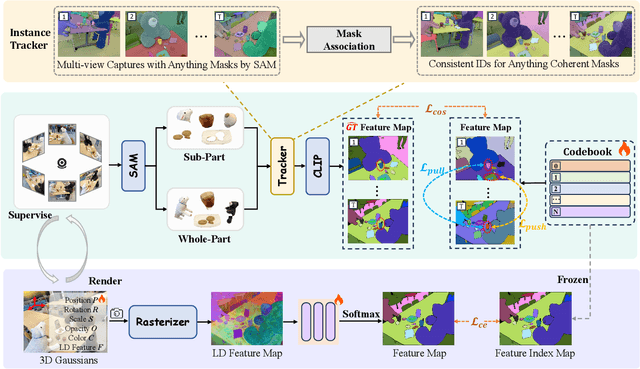
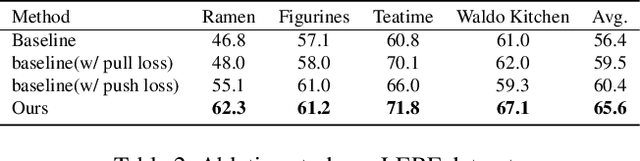
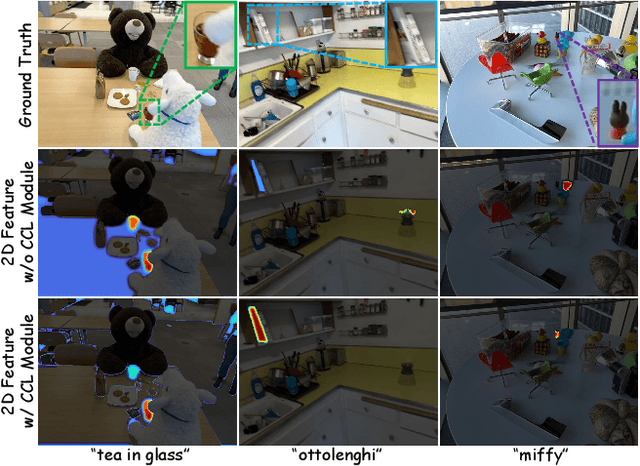
Recent advances in 3D reconstruction techniques and vision-language models have fueled significant progress in 3D semantic understanding, a capability critical to robotics, autonomous driving, and virtual/augmented reality. However, methods that rely on 2D priors are prone to a critical challenge: cross-view semantic inconsistencies induced by occlusion, image blur, and view-dependent variations. These inconsistencies, when propagated via projection supervision, deteriorate the quality of 3D Gaussian semantic fields and introduce artifacts in the rendered outputs. To mitigate this limitation, we propose CCL-LGS, a novel framework that enforces view-consistent semantic supervision by integrating multi-view semantic cues. Specifically, our approach first employs a zero-shot tracker to align a set of SAM-generated 2D masks and reliably identify their corresponding categories. Next, we utilize CLIP to extract robust semantic encodings across views. Finally, our Contrastive Codebook Learning (CCL) module distills discriminative semantic features by enforcing intra-class compactness and inter-class distinctiveness. In contrast to previous methods that directly apply CLIP to imperfect masks, our framework explicitly resolves semantic conflicts while preserving category discriminability. Extensive experiments demonstrate that CCL-LGS outperforms previous state-of-the-art methods. Our project page is available at https://epsilontl.github.io/CCL-LGS/.
Learning to Rank Chain-of-Thought: An Energy-Based Approach with Outcome Supervision
May 21, 2025Mathematical reasoning presents a significant challenge for Large Language Models (LLMs), often requiring robust multi step logical consistency. While Chain of Thought (CoT) prompting elicits reasoning steps, it doesn't guarantee correctness, and improving reliability via extensive sampling is computationally costly. This paper introduces the Energy Outcome Reward Model (EORM), an effective, lightweight, post hoc verifier. EORM leverages Energy Based Models (EBMs) to simplify the training of reward models by learning to assign a scalar energy score to CoT solutions using only outcome labels, thereby avoiding detailed annotations. It achieves this by interpreting discriminator output logits as negative energies, effectively ranking candidates where lower energy is assigned to solutions leading to correct final outcomes implicitly favoring coherent reasoning. On mathematical benchmarks (GSM8k, MATH), EORM significantly improves final answer accuracy (e.g., with Llama 3 8B, achieving 90.7% on GSM8k and 63.7% on MATH). EORM effectively leverages a given pool of candidate solutions to match or exceed the performance of brute force sampling, thereby enhancing LLM reasoning outcome reliability through its streamlined post hoc verification process.
CARES: Comprehensive Evaluation of Safety and Adversarial Robustness in Medical LLMs
May 16, 2025Large language models (LLMs) are increasingly deployed in medical contexts, raising critical concerns about safety, alignment, and susceptibility to adversarial manipulation. While prior benchmarks assess model refusal capabilities for harmful prompts, they often lack clinical specificity, graded harmfulness levels, and coverage of jailbreak-style attacks. We introduce CARES (Clinical Adversarial Robustness and Evaluation of Safety), a benchmark for evaluating LLM safety in healthcare. CARES includes over 18,000 prompts spanning eight medical safety principles, four harm levels, and four prompting styles: direct, indirect, obfuscated, and role-play, to simulate both malicious and benign use cases. We propose a three-way response evaluation protocol (Accept, Caution, Refuse) and a fine-grained Safety Score metric to assess model behavior. Our analysis reveals that many state-of-the-art LLMs remain vulnerable to jailbreaks that subtly rephrase harmful prompts, while also over-refusing safe but atypically phrased queries. Finally, we propose a mitigation strategy using a lightweight classifier to detect jailbreak attempts and steer models toward safer behavior via reminder-based conditioning. CARES provides a rigorous framework for testing and improving medical LLM safety under adversarial and ambiguous conditions.